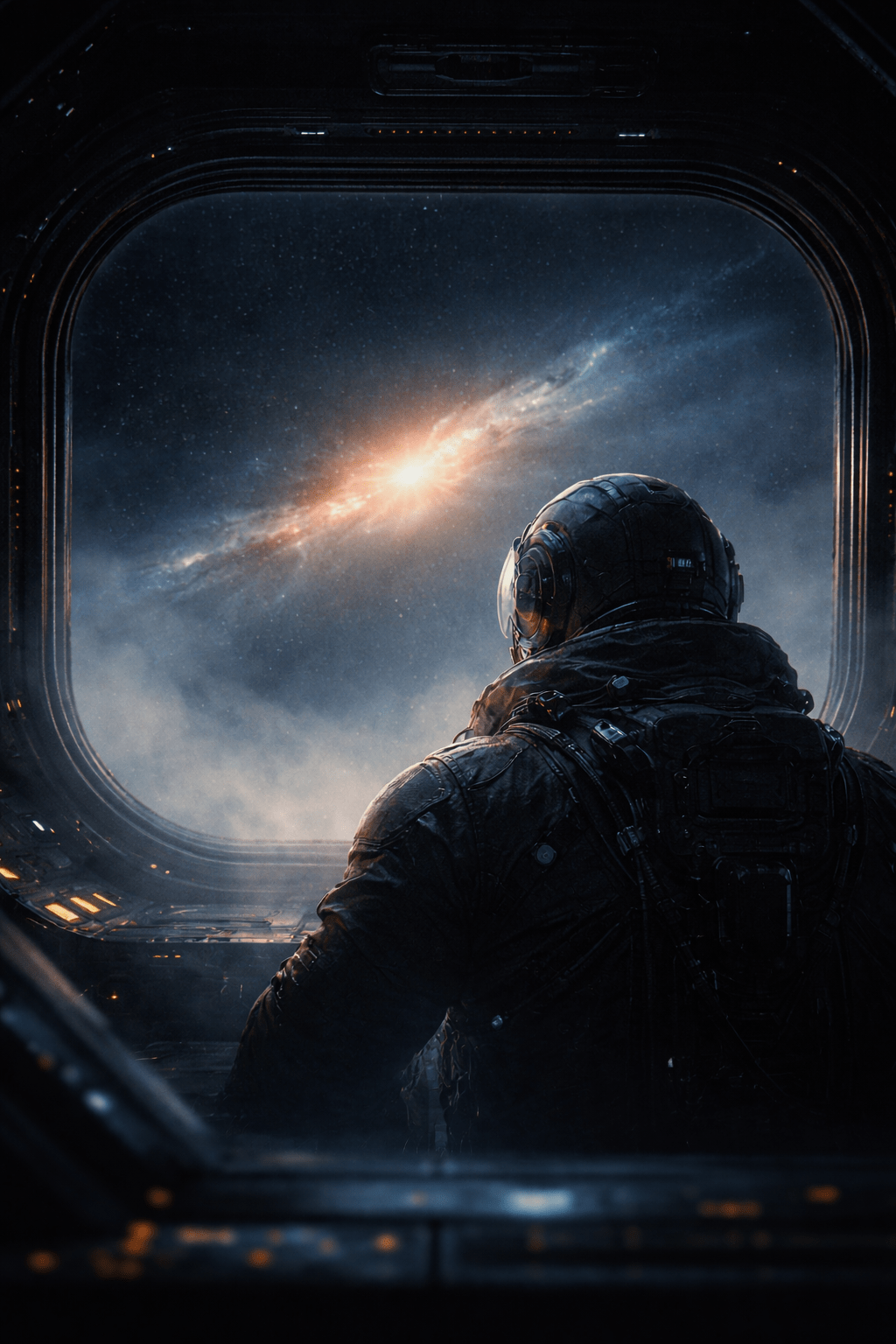
Machine is the emotional ignition point of Light Years Away. It is where the story truly begins. This is the moment when the guy decides, consciously or not, to trade human intimacy for something that will not hurt him.
This song is not about technology. It is about dissociation.
From the very first lines, the narrator is not angry or dramatic. He does not beg or fall apart. He quietly withdraws. Instead of reaching toward love, he reaches toward systems. Toward things that are predictable, controllable, and numb.
“I’ve fallen in love with the engine sound
with the static that keeps me alive.”
This is not romance with a machine. It is a trauma response. The engine and the static represent stability and repetition. They represent something that does not ask questions or risk rejection. When a heart is broken deeply enough, numbness can feel safer than connection.
He is already separated from life before the song even fully unfolds.
“The glass between me and the dark still fogs when I remember you.”
He is not in the dark. He is behind it. There is a barrier between him and real emotion. He can still see it, still feel its presence, but he cannot reach it anymore. Memory creates fog, not clarity.
Even music, which is usually a place of embodiment, becomes detached.
“My hands are ghosts on silver keys.”
He is playing. He is creating. But he is not inhabiting himself. He is present in action but absent in spirit. That line is one of the clearest indicators that this is not a song about escape. It is about disconnection.
The space imagery that appears throughout the song is not escapism. It is emotional armor. Human closeness becomes orbit. City lights turn into satellites. Love becomes signal instead of touch.
He knows exactly what he is doing.
“The Milky Way drips like a wound still bleeding light from something doomed
I can’t tell if it’s beautiful or if it’s just the end made musical.”
That line is the philosophical core of the entire album. Is transcendence real, or is it just grief dressed up in prettier lighting. Is he becoming something greater, or is he slowly disappearing and calling it evolution.
By the end of the song, he admits the cost.
“If I ever see your face again
I won’t come back the same.”
This is not a promise of reunion. It is a warning. Whatever he is becoming cannot coexist with who he was.
How the harmony tells the same story
Machine is written in C minor, but it refuses to behave like a typical minor key song. Instead of using the dominant chord G to create motion and resolution, the harmony circles endlessly through a descending loop:
Cm to B flat to A flat
i to VII to VI
This progression feels like falling rather than moving forward. It pulls backward into memory instead of pushing toward change. That harmonic gravity mirrors the narrator’s emotional withdrawal. He is not traveling. He is drifting.
The VI chord, A flat, appears constantly and often as A flat major seven. In minor keys, the VI chord represents warmth, memory, and emotional safety. Adding the major seven makes it even more suspended and dreamlike. Every time the song approaches pain, it sinks into A flat like a sedative.
The dominant chord, G, which would normally act as the engine that pulls the song forward, is avoided almost entirely. It’s replaced instead with g minor. When the G (specifically G7) finally appears near the end and resolves to C minor, it does not feel triumphant. It feels like a painful awakening. That moment lines up with the realization that he cannot go back unchanged.
Even the mantra section, “mission time endless,” locks the harmony into a closed loop of E flat to G minor to C minor. The music itself becomes a feedback circuit. The machine is no longer something he uses. It is something he lives inside.
How the sound design completes the story
The production of Machine feels regulated rather than alive. The tempo is slow but unwavering, like a monitored heartbeat. Nothing rushes. Nothing breathes. Everything is controlled.
The textures are glassy, filtered, and distant. There is very little warmth in the midrange. The vocal does not sit on top of the mix. It is embedded inside it. The singer is not commanding the sound. He is being absorbed by it.
Reverb is used to create distance, not grandeur. Sounds trail away like signals losing strength. Even the beautiful moments feel lonely.
The machine is seductive. It sounds smooth, soft, and comforting. That is the danger. It does not hurt him. It simply replaces him.
What Machine really is
Machine is the moment when love becomes unsustainable and numbness becomes survivable.
It is a man choosing quiet over connection.
Systems over vulnerability.
Orbit over touch.
This is why the girls later becomes Static, Frequency, Letters, and Memory. He becomes the absence that makes those states necessary.
Machine is not the beginning of a space journey.
It is the beginning of emotional disappearance.
 Zander Parks
Leave a comment