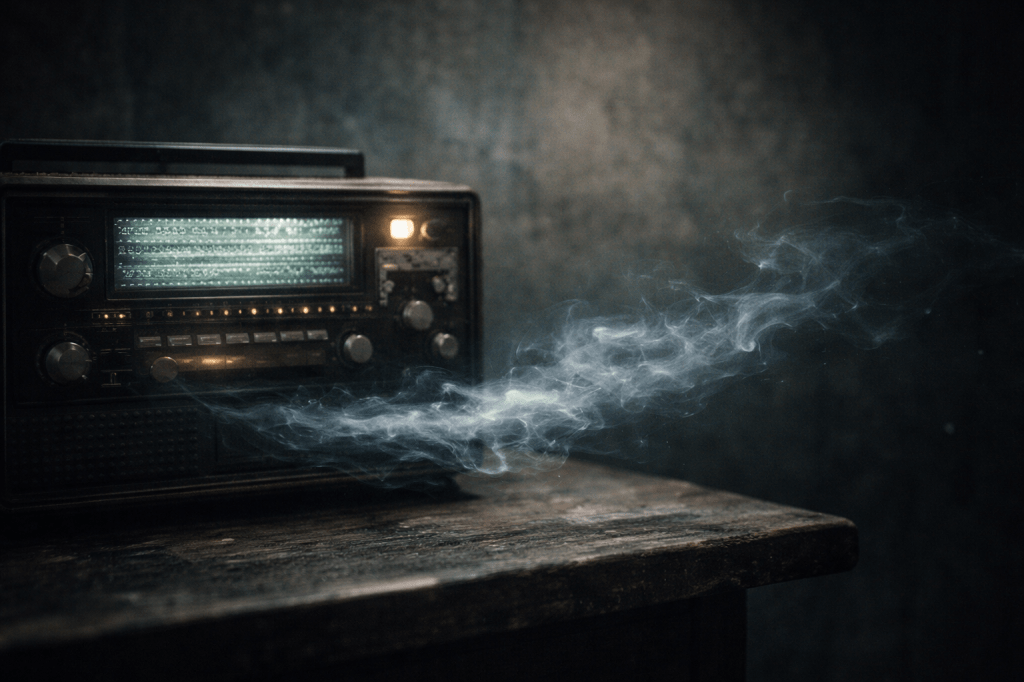
Static is the emotional counterweight to Light Years Away. Where Machine is the moment the story turns inward, Static is where the damage becomes visible. This is where the cost of disappearance is felt by the one who did not choose it.
This song is not about memory.
It is about rupture.
This is the girl’s voice. Unlike the guy, she does not get to withdraw. She does not get to replace feeling with systems or distance. When he vanishes, she does not experience it as something gradual or explainable. It happens all at once.
“There was a sound, just a flicker, like a radio that dies.”
The loss is instantaneous. Not a fade. A cut.
“I called your name, but it fractured, like a signal cut in half.”
Language itself breaks when he leaves. Words are no longer stable because the person they were meant for no longer exists in her world. Speech becomes interference. Meaning becomes noise. She is not trying to understand what happened. She is trying to locate something that suddenly disappeared.
Where the guy turns himself into a system, the girl turns into a listener.
“But I listen every night.”
“I trade the whole horizon for one second of your light.”
She does not move on. She tunes in. She keeps adjusting the dial, not because she expects an answer, but because silence feels worse than static. This is not hope in a romantic sense. It is compulsion. If she stops listening, then the loss becomes final.
This is why the song is called Static. It is not communication. It is what remains after communication collapses. The ghost of a signal still filling the air long after the voice is gone.
How the harmony tells the same story
Static is written in D minor, and it behaves like someone trapped inside a single moment that never resolves.
For long stretches, the harmony barely moves:
Dm to Dmadd9
This is not progression. It is suspension. The music circles the exact instant he vanished, unable to leave it behind. The added ninth does not brighten the chord. It stretches it, like time pulling thin around grief.
When other chords appear, they are primarily B flat major seven and G minor. These are not forward-moving harmonies. They are inward ones. They feel like memory and reflection rather than action. Each time they arrive, the song folds back into itself.
The VII chord, C, appears briefly at moments of emotional strain, but it never resolves into stability. It always falls back into D minor. Every attempt to move forward collapses back into loss. The harmony reinforces what the lyrics already know. She is not healing. She is replaying.
Near the end, there is a fleeting shift to D major. It feels like light breaking through for a moment. Not relief. Possibility. But it does not last. The song sinks back into minor, just as she sinks back into listening.
How the sound design completes the story
The production of Static is the opposite of Machine.
Where Machine is regulated and contained, Static is exposed and unstable. The track feels wide, hollow, and air-filled, as if the center has been removed. The space is not cosmic. It is empty.
The vocal is not buried or protected. It stands alone in the mix, reaching outward into nothing. Reverb does not create grandeur here. It creates absence. It sounds like a room where someone used to be.
Silence matters as much as sound. The static hurts not because it is loud, but because it fills the space where a voice should be. It is the residue of presence.
What Static really is
Machine is someone choosing to disappear.
Static is what it feels like to be the one left behind.
The guy becomes a system.
The girl becomes a signal.
She does not escape.
She listens.
Static is not grief moving forward.
It is grief refusing to resolve.
It is the sound of connection breaking,
and the unbearable quiet that follows.
 Zander Parks
Leave a comment